Saving Ships, Saving Fish: The Hammond Bay Station
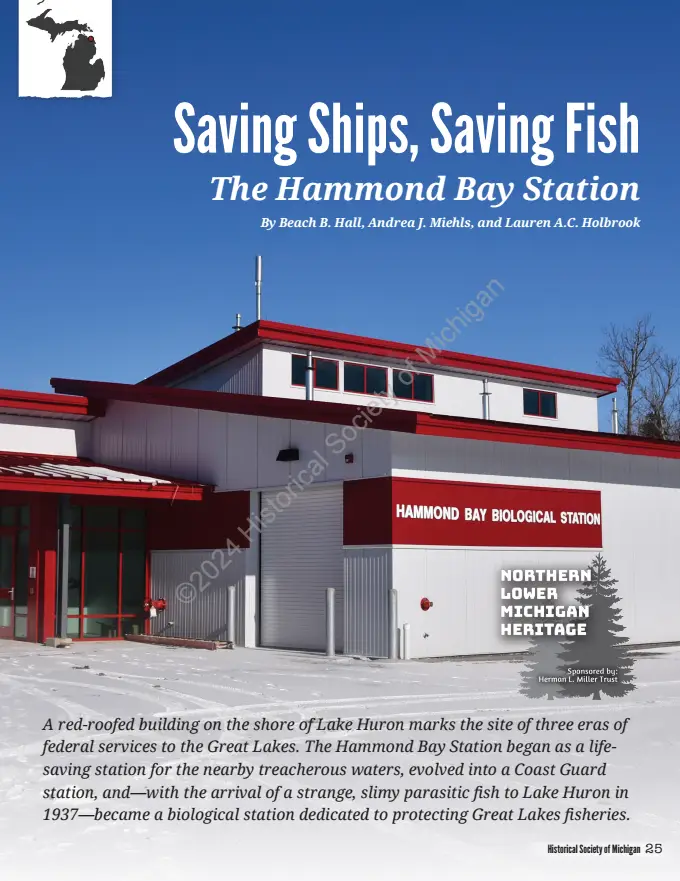
Saving Ships, Saving Fish traces the history of the Hammond Bay Station near Rogers City, Michigan, from its beginnings as a nineteenth-century U.S. Life-Saving Service station rescuing ships and sailors on Lake Huron to its modern role in protecting Great Lakes fisheries. The article highlights how the station evolved into a center for pioneering sea lamprey research and control, helping reverse one of the most devastating invasive species impacts in Great Lakes history and contributing to the restoration of a fishery now valued at more than $5 billion annually. This article was first published in Michigan History Magazine (April/May 2024) by the Michigan History Society in partnership with the Great Lakes Fishery Commission. We gratefully acknowledge authors Beach B. Hall, Andrea J. Miehls, and Lauren A.C. Holbrook for documenting the unique legacy of a site that has spent nearly 150 years safeguarding both people and fish across the Great Lakes.
LeBlance Fish Tales
This book was authored by Peter LeBlance (2021) and shares stories about the LeBlance commercial fishing family who operated on the Great Lakes. This book is available for purchase from Amazon.com
History of the walleye fisheries of Saginaw Bay, Lake Huron
This historic Fisheries Research Report (No. 1850) was published by the Michigan Department of Natural Resources, authored by James Schneider (November 1977). This report documents the history and trends of Saginaw Bay walleye fisheries from commercial to recreational fisheries; and also documents ecological and management issues and trends facing sustainability of these important fisheries in the region. This fisheries research report is archive online in the Michigan Department of Natural Resources Fisheries Library.
Five Men and a Boat, The Remarkable Story of the Early Maritime Family of Johann Lutz
This book researched and written by Thomas Lutz (2019) shares research and stories from the early maritime family of Johann Lutz. This Great Lakes commercial fishing family played an influential role in the early commercial fisheries of the upper Midwest. This book is available for purchase from the Sheboygan County Historical Research Center.
Great Lakes Sea Lamprey, the 70 Year War on a Biological Invader
Great Lakes Sea Lamprey (2019) is a book written by Cory Brant (forward by Jerry Dennis) exploring history of Great Lakes Sea Lamprey invasion, issue, and management. Cory Brant is a researcher at the U.S. Geological Survey Great Lakes Science Center in Ann Arbor, Michigan. For over a decade, his work has focused on sea lampreys, particularly the species’ use of chemical communication and how to exploit that biology as a method of control. Book is published by University of Michigan Press, and described by Press as follows: The stuff of nightmares in both their looks and the wounds inflicted on their victims, sea lampreys (Petromyzon marinus) are perhaps the deadliest invasive species to ever enter the Great Lakes. At the invasion’s apex in the mid-20th century, harvests of lake trout (Salvelinus namaycush), the lampreys’ preferred host fish in the Great Lakes, plummeted from peak annual catches of 15 million pounds to just a few hundred thousand pounds per year—a drop of 98% in only a few decades. Threatening the complete collapse of the fishery, the sea lamprey invasion triggered an environmental awakening in the region and prompted an international treaty that secured unprecedented cooperation across political boundaries to protect the Great Lakes. Fueled by a pioneering scientific spirit, the war on Great Lakes sea lampreys led to discoveries that are the backbone of the program that eventually brought the creature under control and still protects the largest freshwater ecosystem in the world to this day. Great Lakes Sea Lamprey draws on extensive interviews with individuals who experienced the invasion firsthand as well as a trove of unexplored archival materials to tell the incredible story of sea lamprey in the Great Lakes—what started the invasion, how it was halted, and what this history can teach us about the response to biological invaders in the present and future. Richly illustrated with color and black & white photographs, the book will interest readers concerned with the health of the Great Lakes, the history of the conservation movement, and the ongoing threat of invasive species. “Cory Brant delivers the definitive history of the sea lamprey in the Great Lakes, weaving together personal interviews, scientific information, compelling stories of invasion and discovery, and the histories of shipping, commercial fishing, the Erie and Welland Canals, and the locks at Sault Ste. Marie—all in dovetail with the life history of the lamprey.”—Jerry Dennis, author of The Windward Shore: A Winter on the Great Lakes and The Living Great Lakes: Searching for the Heart of the Inland Seas
Through Waves and Gales Come Fishermen’s Tales, Volume 1
Book by Trygvie Jensen (2009) compiles oral histories and stories from those involved in commercial fisheries of northern Lake Michigan and Door County (Wisconsin) waters. Autor describes this book as follows: “This book will take you on a journey into the lives of the men and their families involved in a commercial fishery. The perilous adventures and colorful tales of the fishermen who put their lives in danger on the water will give you a porthole view of their lives on the Great Lakes. Interviews and reflections by the few remaining commercial fishermen documented in Through Waves and Gales Come Fishermen’s Tales details a comprehensive oral history of the last century. Accounts and reflections of harrowing stories while caught in violent storms and ice shoves, along with strange occurrences and humorous stories, will captivate the reader’s attention and provide insight into a day in the life of a commercial fisherman eeking out a living. More importantly, the book will give the reader a better understanding of what sort of challenges that commercial fishermen have endured over the last seventy years.”
Cultures and Ecologies, A Native Fishing Conflict on the Saugeen-Bruce Peninsula
Cultures and Ecologies: A Native Fishing Conflict on the Saugeen-Bruce Peninsula is a book written by Edwin C. Koenig, published in 2005 by the University of Toronto Press (where the book is available for purchase). A brief description of the book is provided by the University of Toronto Press as follows: In 1993, an Ontario Court decision recognized Native rights to harvest fish in the waters around the Saugeen-Bruce Peninsula, sparking sometimes violent confrontation between Native and non-Native fishers about how these rights would be translated into equitable resource access for all. In Cultures and Ecologies, Edwin C. Koenig applies ethnohistorical and ethnographic approaches to the conflict, exploring both historical and recent fisheries activity in the region. In an effort to clarify particularly contentious issues, he provides insights into how the conflict was entangled with cultural perspectives on the definition of ‘conservation’ and how each side had various interpretations of the conservation mandate. Based on substantial ethnographic fieldwork and featuring rich interviews with First Nations members, Cultures and Ecologies links perspectives on fishing conflict issues to local community revitalization efforts, where there is also a strong interest in articulating traditions and traditional knowledge. It encourages an open dialogue on this and other aboriginal resource conflicts.
Bounty & Bust -Commercial Fishing in Saugatuck-Douglas, 1860-1970
This book explores the history and heritage of Lake Michigan fisheries of the Saugatuck-Douglas area. From the late 1860s to the late 1960s, commercial fishing was a vital part of Saugatuck-Douglas, a community at the mouth of the Kalamazoo River in Michigan. This richly illustrated book tell the story of the families, the tugs, the gear and even the fish. Published in conjunction with the exhibition, Saugatuck’s Historic Demerest Shanty: A Tribute to Our Commercial Fishing History. Book is written by Sally Winthers and Randy Dirosa and published by the Saugatuck-Douglas History Center (2020); and is available for purchase online.
Wooden Boats and Iron Men
This book by Trygvie Jensen (2007) presents, “A complete history of an industry that sustained many communities around Lake Michigan and Door County for over 150 years. Today the commercial fishery is a mere shadow of what it once was, and is nearing the end of a once great era. Read about the lives of these iron men who fished in the wooden boats.” Excerpts from authors description of book contents include: “This book will take you back in time and show how the fisheries were an integral part of the Door County and Washington Island communities, and will give the reader an inside look at how a fishery operates. It also gives insight and a personal view of a day in the life of a fisherman. It covers every facet of the industry, from the evolution of the boats, common types of gear used in the last one hundred-fifty years, the species of fish that made up the great harvests, and the invader species that almost wiped out the industry in the mid to latter part of the twentieth century.” “The harrowing stories of fishermen caught in violent storms, ice shoves, and many other stories will that will give the reader insight to what a commercial fisherman went through to eek out a living on the Great Lakes. It will also give the reader a better understanding of what sort of challenges that befell commercial fishermen in the last century and a half and what the future may hold for the fisheries in the next century, through many interviews and reflections by the few remaining commercial fishermen. “ “The data for this book was compiled through several hundred hours of research through various personal interviews with fisher families, history gathered from archives, historical societies, books, published and unpublished manuscripts, databases, periodicals, and online sources.”
Once Upon an Isle – Story of Fishing Families on Isle Royale
Book by Howard Sivertson, published by Wisconsin Folk Museum, 1992. This book shares paintings and stories about life growing up as part of a fishing family on Isle Royale, a remote island located in Michigan waters of Lake Superior.