Know Your Nets
Learn about the types of fishing nets in the Great Lakes.
Trap Netting
This web page is on of the few resources describing Great Lakes trap nets boat. A short article describing trap netting and trap net boats on Lake Erie is research available on the The Ohio State University’s Center for Folklore . Learn more at this website.
Northwest Lower Michigan Fisheries Heritage, Travel, Tourism, & Fish
Historically, and still today, recreational and commercial fish and fishing for northern Lake Michigan communities reflects an important way of life. Posted on August 29, 2014 by Mark Breederland, Michigan State University Extension, Michigan Sea Grant and Brandon Schroeder, Michigan State University Extension, Michigan Sea Grant Click Here to READ FULL ARTICLE Fish tugs, Janice Sue and Joy, in Leland’s historic Fishtown. Photo credit: Keith Burnham. Coastal northwest lower Michigan is filled with scenic landscapes, orchard and agricultural abundance and coastal towns—and rich in Great Lakes fisheries heritage and tradition. These coastal fishing towns are known today for diverse tourism, recreational boating and fishing opportunities. In fact, the Lake Michigan coastline of northwest Michigan and its Leelanau County peninsula was once lined by numerous commercial fishing operations fishing. Still active today, there is a strong remnant of these commercial fisheries—both tribal and state licensed commercial fishers operating out of Pewshawbestown and Leland’s historic Fishtown. Fishing for food, they return catches of whitefish (Coregonus clupeaformis) and other species for local restaurants and families. In addition, fishing for fun (and food), recreational fisherman actively troll and fish waters of Grand Traverse Bay and open Lake Michigan for a variety of species including King & coho salmon, lake trout, perch, smallmouth bass, and others. Both the commercial and recreational sides of fishing on Lake Michigan reflects a way of life for many in this region, contributing to community culture and character as much today as they have in the past. A new Michigan’s Great Lakes Fisheries Heritage Trail offers a great opportunity to learn about fish and people of northwest Michigan, bringing to life today’s Great Lakes fisheries through exploration of the historic fisheries of our past. This statewide trail highlights a wealth of places and experiences available to those interested in learning more about our Great Lakes fisheries. Michigan Sea Grant and Michigan State University Extension have been collaborating with many museums, university, agency and fishing industry partners from across the state in establishing this heritage tourism trail as a resource for communities and travelers, alike. Here are a few places well worth exploring to experience fish and fishing heritage and traditions of northwest Lower Michigan: Leland and Leland’s Historic Fishtown—at Fishtown, you can experience a living active fishery, both tribal and state licensed, where food fish arrive dockside several times per week. Whitefish are caught in trapnets and brought aboard historic fishboats, such the Joy and Janice Sue. You can enjoy the smell of smoked fish in the air, purchase fresh or smoked fish at Carlson’s Fishery or grab dinner at the Bluebird Restaurant & Tavern where authentic images of commercial fishing families of Leland hang; you might also want to visit the Leelanuau Historical Museum just a few steps away from Fishtown where various museum displays are available. Glen Haven and Sleeping Bear Dunes National Lakeshore— visit the fishing vessel Aloha on display at Glen Haven, and explore the world of small boats at the Cannery Boathouse Museum in Glen Haven (largest public exhibit of Great Lakes small craft); also consider stopping by the Sleeping Bear Point Coast Guard Station Maritime Museum while in Glen Haven— this original Sleeping Bear Point U.S. Life-Saving Station was used to rescue mariners from the treacherous waters of Sleeping Bear Point and the Manitou Passage. Northport— Great Lakes sport trolling was invented and pioneered off Northport in the early 1920s. George Raff was the first to discover that lake trout could be caught by trolling in Grand Traverse Bay’s protected waters, and this method that he and his wife, Nell, developed has spread throughout the Great Lakes. A Michigan Historical Marker notes this key development inside the G. Marsten Dame Marina in downtown Northport. Pewshawbestown— fish may be available for purchase near the Arthur Duhammel Marina. Greilickville—Kids looking for a place to explore and learn about fish? Visit the Great Lakes Children’s museum where fun hands-on activities are found in abundance. Also see the rest of the Discovery Center – Great Lakes, which includes the Grand Traverse Bay Watershed Center and the Maritime Heritage Alliance, and schooner Madeline Suttons Bay— visit the renowned Inland Seas Education Association education center and sail aboard schooner Inland Seas where you can learn about native Great Lakes ecology and aquatic invasive fish like the Asian carp, which threaten to enter the Great Lakes. Traverse City—How about hands-on fishing with captains of the Michigan Charter Boat Association? A future fishing pier is under active planning and development in Traverse City at the mouth of the Boardman River in Downtown Traverse City. Interested in learning more about our Great Lakes fisheries of past and present? Michigan Sea Grant offers online educational resources, including publications such as “The Life of the Lakes: A Guide to the Great Lakes Fishery.” This article was published by Michigan State University Extension. For more information, visit http://www.msue.msu.edu. To have a digest of information delivered straight to your email inbox, visit http://www.msue.msu.edu/newsletters. To contact an expert in your area, visit http://expert.msue.msu.edu, or call 888-MSUE4MI (888-678-3464).
Great Lakes Fisheries Experiences Abound in Northeast Michigan
Northern Lake Huron is rich in Great Lakes fisheries heritage and tradition, from historic commercial to current day recreational fisheries, offering value for communities and visitors alike. Posted on June 6, 2014 by Brandon Schroeder, Michigan State University Extension CLICK HERE to Read Full Article online Diversity of fish and fishing experiences along Lake Huron’s sunrise side offers a wealth of opportunities for visitors and communities of northeast Michigan. Photo credit: Brandon Schroeder The coastal Lake Huron communities of northeast Michigan are rich in Great Lakes fish and fishing, heritage and traditions. These Lake Huron fisheries (both fish and people fishing) reflect a way of life for local communities and contribute to sustainable coastal tourism development opportunities as much today as they have in the past. A diversity of fish—some 115 species—inhabit the waters of Lake Huron providing a wealth of food, fun, ecological and economic values. Anglers enjoy equally diverse recreational fishing opportunities from offshore salmon, steelhead and lake troutto more near shore walleye, perch, pike and bass—among many other species to be caught. Lake Huron also provides the largest catch of lake whitefish, a popular food fish, accounting for approximately half of all whitefish commercially harvested across the Great Lakes. These dynamic and ever-changing Lake Huron fisheries provide many values and benefits across coastal communities of northeast Michigan. A new Michigan’s Great Lakes Fisheries Heritage Trail offers coastal tourism promise, bringing to life today’s Great Lakes fisheries through exploration of the historic fisheries of our past. This statewide trail highlights a wealth of places and experiences available to those interested in learning more about our Great Lakes fisheries. Michigan Sea Grant and Michigan State University Extension have been collaborating with many museum, university, agency and fishing industry partners from across the state in establishing this heritage tourism trail as a resource for communities and travelers, alike. A visit to northeast Michigan offers a chance to explore these Great Lakes fisheries heritage experiences: Interested in learning more about these Great Lakes fisheries? Michigan Sea Grant offers educational resources online, including publications such as “The Life of the Lakes: A Guide to the Great Lakes Fishery.” Visiting coastal northeast Michigan? Plan your trip by visiting the U.S. 23 Huron Shores Heritage Route website at http://www.us23heritageroute.org/. This article was published by Michigan State University Extension. For more information, visit http://www.msue.msu.edu. To have a digest of information delivered straight to your email inbox, visit http://www.msue.msu.edu/newsletters. To contact an expert in your area, visit http://expert.msue.msu.edu, or call 888-MSUE4MI (888-678-3464).
Great Lakes Fisheries Heritage Trail – People, Fish, & Fishing
Celebrate and experience our Great Lakes fisheries heritage while traveling Michigan. Posted on January 25, 2016 by Brandon Schroeder, Michigan State University Extension, Michigan Sea Grant From lighthouses to shipwrecks, Michigan is rich in maritime heritage tradition. Great Lakes fisheries – fish and people who fish – have significantly benefited coastal communities, the Great Lakes region and the nation throughout history and still today. Ecologically, economically and recreationally valuable, Great Lakes fisheries have supported people and communities for generations. Great Lakes fish and fishing – tribal, commercial, and recreational – have shaped the culture, economy, and quality of life for people in Michigan. A new Great Lakes Fisheries Heritage Trail offers opportunity to explore the past, present and future of the lakes through the lens of fish and fishing. Museum exhibits and educational opportunities, events and experiences along this trail highlight our fisheries heritage, ecology, management, and the economic and social issues that have defined Michigan’s coastal communities. Valued Great Lakes fisheries: Of national significance, the Great Lakes encompass more than 11,000 miles of shoreline and contain about 20 percent of world’s surface freshwater. The lakes are home to a diversity of Great Lakes fish species valued for their food and recreational contributions, ecological and economic significance. Food – close to 150 million pounds of Great Lakes fish were harvested annually at the turn of the twentieth century; these fish were consumed locally and also preserved by salt and ice to be shipped by boat, train and truck to help feed the growing populations across the country. Today, nearly 50 million pounds of fish are sustainably harvested for food. Fun –1.8 million U.S. anglers enjoy fishing recreationally in Great Lakes waters today. With Michigan bordering four of the lakes, it comes as no surprise that fisheries contribute greatly to recreational tourism from coast to coast. Economy – Great Lakes fisheries contribute $4 billion to $7 billion in economic value annually through fishing-related sales, commercial and charter fishing, community tournaments and coastal tourism. Ecology – at least 179 species of fish contribute to biodiversity and healthy Great Lakes ecosystems; and many ecological issues of the past, from water quality to invasive species introductions, remain as relevant and important today. Explore the Great Lakes Fisheries Heritage Trail The Great Lakes Fisheries Heritage Trail network represents a partnership among museum, maritime heritage, and fisheries partners cooperating across Michigan to promote our fisheries heritage. The collective efforts of these partners is helping to preserve and interpret historical artifacts, enhancing local communities and heritage-based tourism, and offering educational opportunities focusing on Great Lakes literacy and stewardship. The trail includes museums, coastal fishing communities, fish markets and processing facilities, events, research and science centers throughout Michigan. Visitors are offered unique opportunities to explore the dynamic social, technological and environmental changes that have shaped today’s fisheries. View an interactive map of Great Lakes Fisheries Heritage Trail sites online. Want to learn more about our Great Lakes fisheries heritage? In future articles, we will explore the fisheries heritage stories as told through the partners and places located along the trail. A Michigan Sea Grant publication The Life of the Lakes: A Guide to the Great Lakes Fisheryalso offers a more in-depth look at the this diverse, dynamic and valuable Great lakes fishery, exploring: Ecology and Management, Today’s Great Lakes Fisheries, History of the Great Lakes Fisheries and the Future of these resources. Michigan Sea Grant helps to foster economic growth and protect Michigan’s coastal, Great Lakes resources through education, research and outreach. A collaborative effort of the University of Michigan and Michigan State University and its MSU Extension, Michigan Sea Grant is part of the NOAA-National Sea Grant network of 33 university-based programs. This article was published by Michigan State University Extension. For more information, visit http://www.msue.msu.edu. To have a digest of information delivered straight to your email inbox, visit http://www.msue.msu.edu/newsletters. To contact an expert in your area, visit http://expert.msue.msu.edu, or call 888-MSUE4MI (888-678-3464).
Great Lakes Fisheries Heritage Trail – Evelyn S. still making history
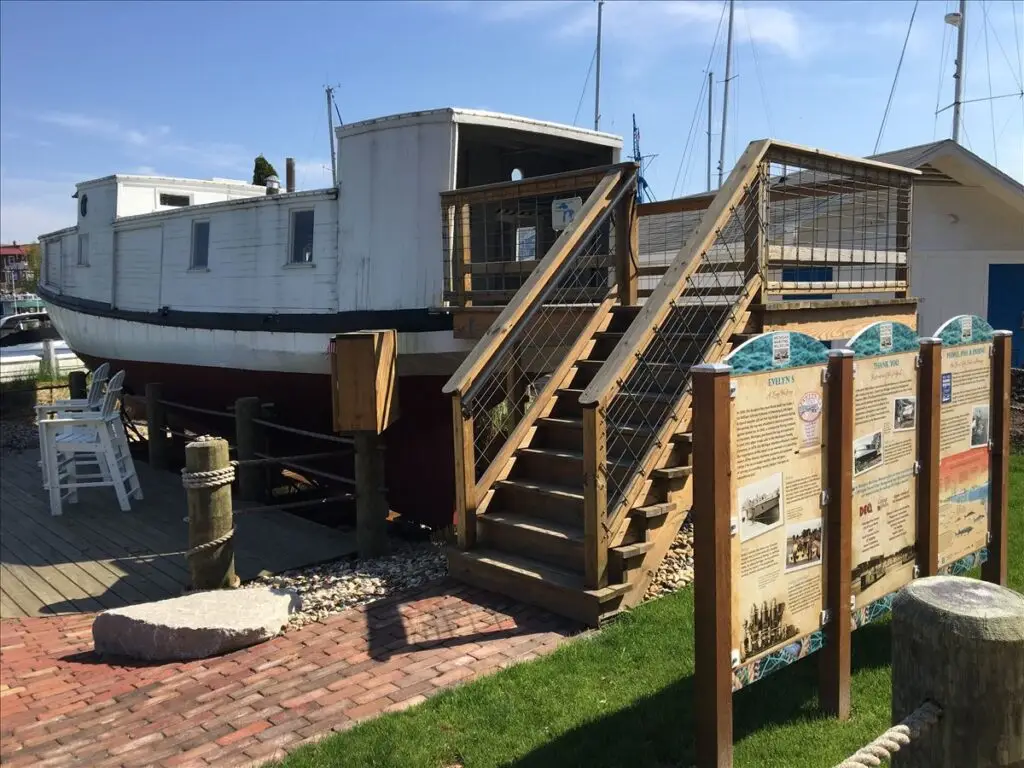
The Michigan Maritime Museum offers visitors the chance to board the historic Great Lakes fish tug Evelyn S. and peer into the daily life of a commercial fisherman. Posted on March 28, 2016 by Dan O’Keefe, Michigan State University Extension, Michigan Sea Grant, and Ashley M. Deming, Michigan Maritime Museum Evelyn S., above, in her new role as an educational exhibit at Michigan Maritime Museum. Below shown in 1950. Photo: Michigan Maritime Museum. A new Great Lakes Fisheries Heritage Trail offers opportunity to explore the past, present and future of the lakes through the lens of fish and fishing (See Part 1, series introduction). In this article, we visit South Haven and the Michigan Maritime Museum to explore commercial fishing heritage of west Michigan as told through the historic commercial fishing vessel, Evelyn S. The Evelyn S. was built in 1939 by Sturgeon Bay Boat Works William Selman Fisheries of Manistique, Mich. She fits the typical wooden gill net fish tug design so prevalent on the waters during this period. Measuring 50 feet long with a 13-foot beam, Evelyn S.also boasts a 3-cylinder Kahlenburg diesel engine (much like the engine aboard the Katherine V. at the Besser Museum in Alpena, Mich.). To extend the life of the vessel, Evelyn S. was also sheathed in steel with a completely enclosed deck to protect her crew against the frozen waters of Lake Michigan. In 1943, Evelyn S. was sold to a commercial fishing company in Frankfort, Mich. Commercial fishing was part of a thriving diverse maritime economy on Lake Michigan from the 1860s to the 1970s,and the Evelyn S. plied the waters of Lake Michigan bringing in catches that helped make local communities such as South Haven flourish. She fished until 1952 when she was sold to a Muskegon towing company. In 1979, the founder of the Michigan Maritime Museum realized the importance of this vessel as an example of a dwindling aspect of the diverse maritime economy and acquired Evelyn S. She soon became a main attraction as an on-water exhibit for the museum in South Haven. After 40 years of serving as a working vessel, Evelyn S. now serves as an educational tool to represent these once common vessels and the important impact they had on local communities. In the early 1980s, the Evelyn S. was restored by the museum as a land-based exhibit after a sinking incident at the museum dock. In 2014 and 2015, Evelyn S. was again restored after the City of South Haven and the museum were awarded a grant from the state Department of Environmental Quality’s Coastal Zone Management Program which was coupled with local funds and volunteer efforts toward this restoration. Evelyn S. was moved to her permanent home on the museum campus and anchored in place. The restoration work, which included making the boat watertight and removing dry rot, was undertaken by Great Lakes Boat Building School graduate Hans Wagner and others. Sanding and painting efforts were conducted by volunteers and museum interns. The interior exhibit will feature commercial fishing artifacts and historic photos for visitors to explore. On the exterior, there is a technology station that features an interactive touch screen that allows visitors to watch this video about commercial fishing and Evelyn S. The restoration and exhibit is scheduled to open May 1, 2016. In addition to a public exhibit, Evelyn S. is also being used in a variety of new educational programming at the museum. In 2015 museum staff worked with Michigan Sea Grant to develop a lesson plan that targeted 3rd through 5th grades. This interactive lesson focuses on STEM (Science, Technology, Engineering, and Math) themes, introducing students to commercial fishing and the changes to the industry over time. The activity touches on invasive species, technological changes, and economic and environmental impacts. Evelyn S. plays an important role in bringing these themes to life for the students. The museum’s 2015 STEM Summer Camp piloted a commercial fishing education program that incorporated this lesson plan, a tour of Evelyn S., and a tour aboard Elsie J., a converted commercial fishing tug owned by the Jensen family who operated a fishery in South Haven until the 1980s. The museum is also working with the South Haven Public School District to develop an educational program around commercial fishing for the 6th grade in which Evelyn S. will play a crucial role. The Michigan Maritime Museum is proud to have Evelyn S. as a part of the Great Lakes Fisheries Heritage Trail linking these vessels and commercial fishing heritage across land and water. Informational signage will be installed in the spring of 2016 to highlight the trail, the history of commercial fishing and Evelyn S., as well as all of the donors, sponsors, and volunteers that made her restoration possible. For more information onEvelyn S. and the museum visit www.michiganmaritimemuseum.org. Michigan Sea Grant helps to foster economic growth and protect Michigan’s coastal, Great Lakes resources through education, research and outreach. A collaborative effort of the University of Michigan and Michigan State University and its MSU Extension, Michigan Sea Grant is part of the NOAA-National Sea Grant network of 33 university-based programs. Read the Fisheries Heritage Trail Series: Part 1- People, fish, and fishing Part 2 – Katherine V. This article was published by Michigan State University Extension. For more information, visit http://www.msue.msu.edu. To have a digest of information delivered straight to your email inbox, visit http://www.msue.msu.edu/newsletters. To contact an expert in your area, visit http://expert.msue.msu.edu, or call 888-MSUE4MI (888-678-3464).
Fish Tugs of the Greatest Lake website
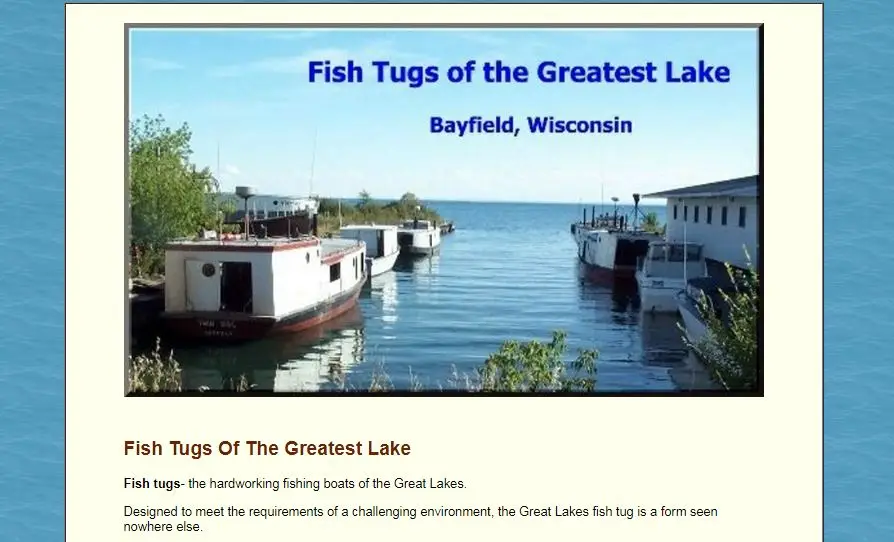
A website created and moderated by Harvey Hadland and Bob Mackreth (2002-2016) documenting fish tugs of the great lakes. A great site to explore images of modern and historic fish tugs. According to website home page, this website offers the following: History: The evolution of fish boat design at Bayfield, Wisconsin. Photo Gallery: Modern and historic images. Fleet Roster: The fishing boats of Bayfield and beyond. The Fishermen: Men of the commercial fishery. Kahlenberg Engine Roster: Some of the boats powered by the famous engine. The Fishing Anthology: A collection of annals and anecdotes related to the Great Lakes commercial fishery. Visit website to explore this information in more detail.