Dockside Fish Market…Fish Tales
Dockside Fish Market …Fish Tales (read online here) DOCKSIDE FISH MARKET FRESH & SMOKED / THE BIG SEA WATER by William Least Heat – Moon Photographs by David Bowman (Gourmet Magazine May 2004) SHELE CLAPP TOFTEY – ONE GREAT FISHING STORY. Why would a woman choose this profession, and where does she find the perseverance? by Anna Klobuchar (The Area Woman Summer 1999)
The Evolution of Great Lakes Commercial Fishing Vessels & Gear – A Brief Overview
The Evolution of Great Lakes Commercial Fishing Vessels & Gear – A Brief Overview From lighthouses to shipwrecks, Michigan is rich in maritime heritage tradition; yet the importance of Great Lakes fisheries as part of our maritime heritage landscape is often untold. Fish have been a critical source of good protein for the people living along these shores for thousands of years. Great Lakes fish and fishing for sustenance, and tribal, commercial, and recreational fishing have shaped the culture, economy, and quality of life for people in the Great Lakes region. At the peak of commercial fishing in the Great Lakes 150 million pounds of fish were being harvested annually. Today, Great Lakes commercial fishing operations sustainably harvest over 40 million pounds annually, between the United States and Canada, providing a significant food source shared around the world. Industry Innovations and Evolution Fisheries heritage stories are often reflected in (and aboard) the fishing boats that carried fisherman to the fish; and these critical fish harvests home to our coastal communities. Great Lakes commercial fishing boats evolved in response to technological advances and changes in the rules and regulations governing commercial fishing. Explore the variety of fishing methods – past and present – deployed by fishermen to follow the fish! Fishing from Shore The Anishinaabek and their ancestors and early settlers fished largely from shore and at the mouths of streams and rivers from canoes or using hand methods such as traps, spear fishing or wading with seine nets that could be pulled by hand in shallow waters. These methods are still regularly used today. Today regulated spear and bowfishing seasons are open for many fish species; and quiet water kayak and canoe fishing grows in popularity. Seine fishing still often used to capture many minnow species important to bait industry supplying recreational fisheries. Mackinaw Boats These 20-35’ seaworthy wooden sailing boats were considered the ‘pickup trucks’ of their time for their versatility in use and ability to work in shallow water and off the beach. For independent fishermen in the 19thand early 20thcentury working pond and gill nets, mackinaw boats were ideal, affordable watercraft. Thousands of mackinaw boats were built by Anishinaabek and non-native boatbuilders for fishing and general transportation. Pound/Pond Net Boats Any small boat could be used to harvest the catch from a pound net. Farmers and other lake-shore dwellers built simple boats to harvest a catch from their near-shore pound nets fish to feed their families and neighbors. The wood flat-bottomed pond net boat with one or two rowing stations was inexpensive and simple to construct. Pound or Pond Netting Fishermen with simple equipment and small boats could work the near-shore fishing grounds with these standing nets. Fastened to stakes, these nets funneled fish into a pen that could be emptied by fishermen working in small boats. Boats that could be rowed (hand-powered) or sailed (wind-powered) offered ability to set and empty nets farther from shore The GreatLakes Gill Net Tug & Gill Nets The enclosed gill net and motorized tug was designed for gill net fishing methods dominated commercial fishing activities through the late 19th and most of the 20th century. Made of wood and later by steel, the entirely enclosed Great Lakes’ fishing tug represents a design unique to the Great Lakes. The ‘turtle backs’ tugs, as are were often called, allows fishermen to pull, empty and reset gillnets in the coldest icy and often rough waters of the Great Lakes. This signature and seaworthy design was found throughout the Great Lakes region. Gill nets are size-selective, meaning the panels of the gill net are designed to allow fish to swim partially through square mesh before the girth of the fish causes it to become entangled. Gill nets could be said to look like a fence that stands or is suspended in the water. Weights are attached along the bottom of the net and floats attached to the top of the nets keep it upright. Trap Net Boats & Trap Nets In the 20th century, Great Lakes fishermen invested in tugs that were designed to set and pull trap net. These boats had a small cabin at the bow and flat open deck with low sides that allowed the fishers to pull their trap net on emptied, then reset. Fish boxes were stacked and secured on the deck. Wood trap nets boats were replaced with steel boats. A trap nets a funnel fish into an enclosed box net (i.e. trap) where they can still swim freely prior to being retrieved. A trap nets allows undesirable fish, due to size or species, to be released without harm when the net is retrieved. Laura J. Quackenbush 09/2018 References: Great Lakes Seaway Trail, Inc.; The Ohio State UniversityCenter for Folklore; Michigan Sea Grant.
Muskie Fishing, Fact and Fancy, Lore and Lures
Muskie Fishing, Fact and Fancy, Lore and Lures (2nd Edition) Book written by and published by Homer LeBlanc (no publishing date on book) Stories and information about fishing for Muskie, centered on Lake St. Clair – also covering bass, walleye, pike and more. Book includes stories, illustrations, along with tips and tactics for fishing muskie and these other species. According to book cover, “this authentic guide book tells you how, what, when and where.” CLICK HERE to read profile about about Muskie fishing legend Homer LeBlanc written by the National Fishing Lure Collectors club (NFLCC).
Environment, Culture, and the Great Lakes Fisheries
ENVIRONMENT, CULTURE, AND THE GREAT LAKES FISHERIES by JOHN C. HUDSON and SUSY S. ZIEGLER ABSTRACT. The commercial fisheries of the United States and Canadian Great Lakes are in a long period of decline. Detailed statistics kept for well over a century document a fluctuating pattern of harvests of the major commercial species. In the 1940s, sea lamprey began to devastate the fisheries, an effect that has not been fully countered. Overfi- shing, nonnative species, declining nutrient levels, and chemical pollution have contributed to reduced catches. Court decisions in the United States and Canada during the past thirty years have awarded a sizable share of commercial fishing rights to Native North Americans for their own support and sustenance. The Lake Erie yellow perch and walleye fishery, based mainly in Ontario, is the most successful commercial fishing operation in the region. Despite the many environmental and cultural challenges, the Great Lakes fisheries live on. Keywords: Canada, fisheries, Great Lakes, United States. Recommended Citation Hudson, J. C. and Ziegler, S. S. (2014), Environment, Culture, and The Great Lakes Fisheries. Geographical Review, 104: 391–413. doi: 10.1111/j.1931-0846.2014.12041.x This Journal Article is brought to you for free and open access by The Commons. It has been accepted for inclusion in Journal Articles by an authorized administrator of The Commons. For more information, please contact kclumpne@nmu.edu,kmcdonou@nmu.edu, mburgmei@nmu.edu, bsarjean@nmu.edu.
Seines to Salmon Charters, 150 Years of Michigan Great Lakes Fisheries
This Michigan Sea Grant Extension Bulletin (E-1000) was written by Suzanne Tainter and Ray White (published May 1977) and describes 150 years of transition in Michigan Great Lakes fisheries, from seines to salmon charters. A variety of fishing boats, gear (from bone hooks to nets to recreational fishing gear), and methods are described in this publication; along with some illustrations and information describing changes in the environment and fish populations that drove some of these changes in the fishery.
An Economy of Scales
An Economy of Scales (Upwellings, March 2015 special edition), explores the food fish industry in Michigan and includes information about: Michigan’s First Annual Seafood Summit Aquaculture and Commercial Fishing Recipes featuring Michigan Farmed and Wild Fish Exploring the Term ‘Sustainable Seafood’
Something Spectacular, My Great Lakes Salmon Story
Something Spectacular: My Great Lakes Salmon Story by Howard A. Tanner Book overview, as provided by Michigan State University Press (read more about book online): As the new chief of the Michigan Department of Conservation’s Fish Division in 1964, Howard A. Tanner was challenged to “do something . . . spectacular.” He met that challenge by leading the successful introduction of coho salmon into the Michigan waters of the Great Lakes. This volume illustrates how Tanner was able to accomplish this feat: from a detailed account of his personal and professional background that provided a foundation for success; the historical and contemporary context in which the Fish Division undertook this bold step to reorient the state’s fishery from commercial to sport; the challenges, such as resistance from existing government institutions and finding funding, that he and his colleagues faced; the risks they took by introducing a nonnative species; the surprises they experienced in the first season’s catch; to, finally, the success they achieved in establishing a world-renowned, biologically and financially beneficial sport fishery in the Great Lakes. Tanner provides an engaging history of successfully introducing Pacific salmon into the lakes from the perspective of an ultimate insider.
Small Fry, Big Catches: The Great Lakes Fishery
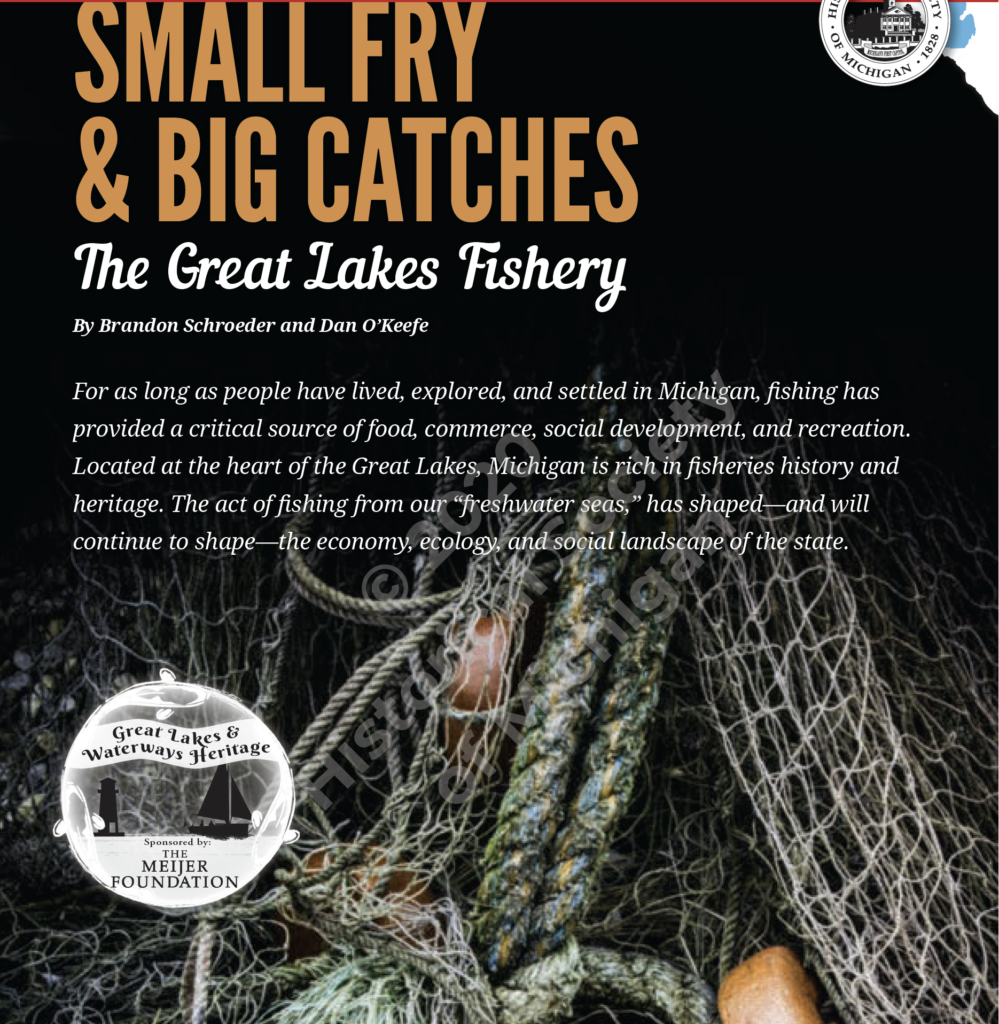
The article—first published in Michigan History Magazine—traces Michigan’s Great Lakes fishery from Indigenous (Anishinaabek) subsistence practices through 19th–20th century commercial growth, technological change (e.g., gill-net tugs, trap nets), ecological disruption and restoration (e.g., sea lamprey control, salmon stocking), policy/regulatory milestones (e.g., Clean Water Act; treaty fishing rights), and contemporary stewardship challenges (habitat, invasives, and allocation of fish among diverse values).
Guide to Great Lakes Fishes
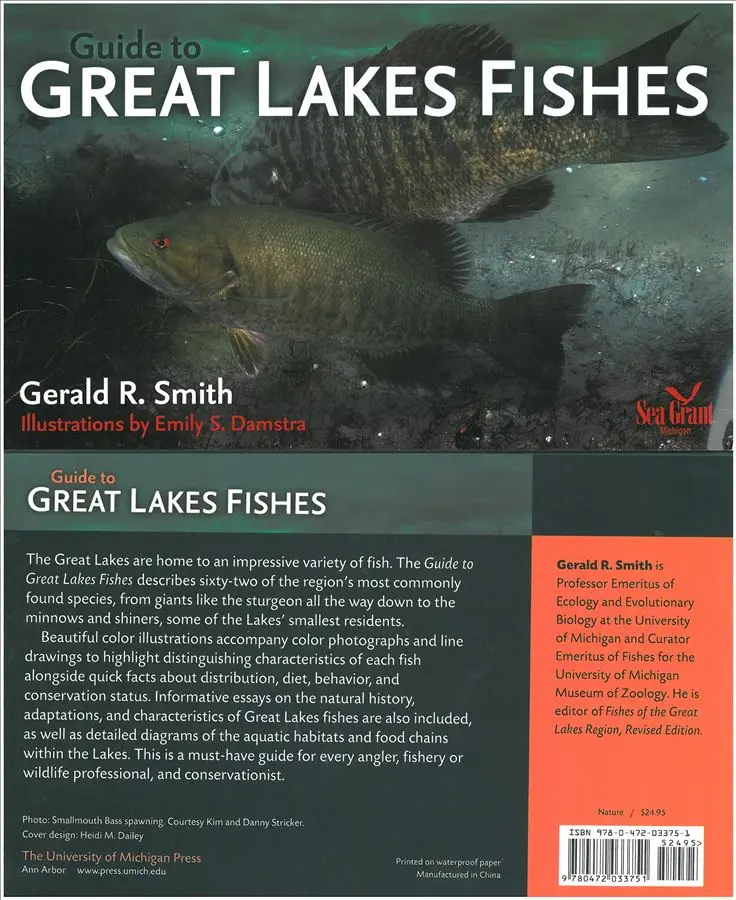
Description presented by University of Michigan Press (view full description online): The Great Lakes are home to an impressive variety of fish. The Guide to Great Lakes Fishes describes sixty-two of the region’s most commonly found species, from giants like the sturgeon all the way down to the minnows and shiners, some of the Lakes’ smallest residents. Beautiful color illustrations accompany color photographs and line drawings to highlight distinguishing characteristics of each fish alongside quick facts about distribution, diet, behavior, and conservation status. Informative essays on the natural history, adaptations, and characteristics of Great Lakes fishes are also included, as well as detailed diagrams of the aquatic habitats and food chains within the Lakes. This is a must-have guide for every angler, fishery or wildlife professional, and conservationist. The paperback edition is printed on waterproof paper. The University of Michigan Press worked in collaboration with Michigan Sea Grant on the development of this guidebook, the second in a series of books about the Great Lakes coast. Gerald R. Smith is Professor Emeritus of Ecology and Evolutionary Biology at the University of Michigan and Curator Emeritus of Fishes for the University of Michigan Museum of Zoology. He is editor of Fishes of the Great Lakes Region, Revised Edition.
Fishes of the Great Lakes Region
Description as presented by University of Michigan Press (read full description online): For everyday anglers, armchair enthusiasts, and serious students, Hubbs and Lagler’s text remains the definitive work in the identification and study of the fishes of this important freshwater region. Organized by fish family, with sections on waters of the Great Lakes region, zoogeography, field study and collection, preservation of fishes for study, fish identification, anatomy, terminology, and more, Fishes of the Great Lakes Region is comprehensive in its scope and breadth of information—truly the classic book on Great Lakes fishes. The book also documents a half century of changes in fish population in the region that have resulted from pollution, development, and the introduction of nonnative species. This edition will thus inspire future generations of anglers and students to take a fresh look at one of our most important fauna. Carl Hubbs and Karl Lagler were influential leaders in twentieth-century ichthyology and fishery management; both broought their knowledgeof fish to the University of Michigan. Gerald R. Smith, Curator Emeritus at the University of Michigan Zoology Museum, is a leading expert in fish identification in the Great Lakes region.